
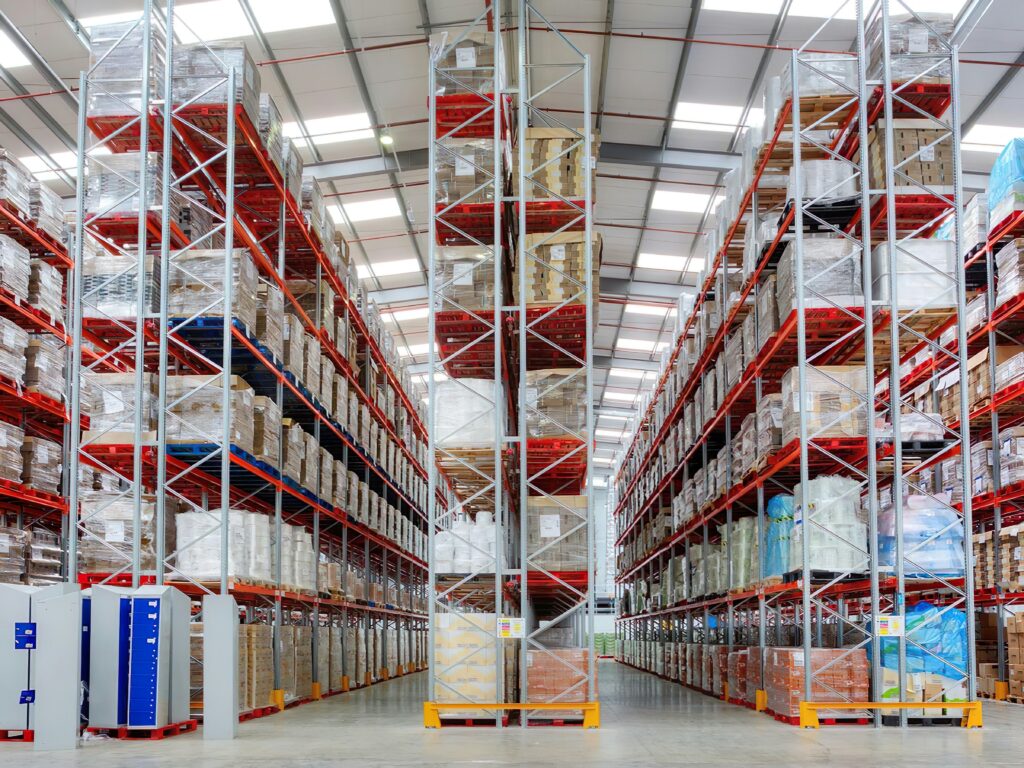
You’re inspecting your warehouse and spot a pallet rack beam that’s bowed more than the others. You wonder: Is this safe? Is it within code? Do I need to shut down this aisle? If this sounds familiar, you’re not alone.
Beam deflection—the downward bending of horizontal rack beams under load—is a top concern for warehouse managers and safety officers. When ignored, it can lead to failed inspections, damaged products, and, worst of all, unstable racks.
This guide is for rack professionals who want clear, practical information on what pallet beam deflection is, how to measure it, how much bowing is acceptable, and what to do if it exceeds safe limits.
Let’s get into it.
What Is Pallet Beam Deflection?
Pallet beam deflection is the downward curvature or sag that occurs in a pallet rack beam when it’s loaded with weight. It is a natural and expected behavior of steel under load.
Why does deflection happen?
Steel is strong but flexible. When weight is applied, the beam bends slightly. The amount it bends depends on:
- The load weight and distribution
- The beam’s length (span)
- The beam’s shape and thickness
- The material properties of the steel
Why does deflection matter?
Excessive beam deflection can:
- Make pallets unstable
- Cause stored materials to fall or lean
- Increase stress on the frame and connectors
- Reduce overall system integrity
- Violate RMI standards
Understanding Pallet Rack Weight Capacity
Every pallet rack beam has two distinct load limits that determine its rating:
1. Maximum strength – how much weight the steel can bear before failing
2. Maximum serviceability – how much weight it can hold before sagging beyond L/180
Your beam’s actual capacity is whichever limit is reached first. Short, deep beams usually hit their strength limit before they bow excessively.
Long, shallow beams typically sag beyond acceptable limits before reaching their breaking point.
Understanding which type you have helps predict how the beam will perform under varying loads.
How to Calculate the Deflection of a Beam
Measuring deflection is straightforward but must be done carefully and accurately. Here’s how:
Step 1: Confirm the Beam’s Load Capacity
Check the manufacturer’s data label or documentation. Make sure you’re reviewing the pallet racking load capacity chart posted at the end of each aisle. Make sure the beam’s current load does not exceed its rated capacity.
Step 2: Measure the Beam Span
Use a tape measure to get the distance between the insides of the vertical uprights (not the total length of the beam).
Example: A common beam span is 96 inches (8 feet).
Step 3: Measure the Beam’s Center Sag
For the most reliable measurement, professional inspectors use a taut string or wire positioned below the beam. By keeping both ends at equal distance from the beam bottom, you eliminate measurement errors caused by sloped floors or connection movement. Mark the beam’s midpoint, then measure the gap difference between the ends and the center.
With the rack fully loaded, measure from the floor to the bottom center of the beam and from the floor to the bottom of the beam at the ends. Subtract the center measurement from the end to get the deflection. When precision matters—such as for compliance documentation—the string technique or laser tools provide superior accuracy compared to tape-measure-only methods.
Example:
- End of beam: 48.0″
- Center of beam: 46.75″
- Deflection = 1.25″
Step 4: Compare to Allowable Deflection Limits
Use the standard deflection formula:
Allowable deflection = Beam span (in inches) ÷ 180
Example:
- 96″ span ÷ 180 = 0.53″ max allowable deflection
If your beam sags more than 0.53″, it exceeds safe limits and may need to be unloaded and replaced.
How Much Bowing in a Beam is Acceptable?
Current Beam Deflection Standards
According to ANSI MH16.1-2023 (Section 9.3):
“The vertical deflection of loaded pallet beams shall not exceed L/180, where L is the center-to-center span length in inches.”
Why Does the L/180 Standard Exist?
In addition to ensuring the product remains soundly on the pallets, the industry settled on L/180 to address human perception rather than engineering failure risk. The limit represents the threshold where most people begin questioning whether the installation is safe.
Some facility managers expect completely straight beams and react with alarm to any visible curve. Designing for near-zero deflection would demand impractically large beam profiles and dramatically increase costs without improving actual safety margins. Even large beams deflect under load, but it may not be detectable by the naked eye.
| Beam Span (in) | Max Allowable Deflection (L/180) |
| 96″ | 0.53″ |
| 108″ | 0.60″ |
| 120″ | 0.67″ |
If a beam bows more than this, it is either:
- Overloaded
- Damaged
- Poor quality
- Or incompatible with the pallet configuration
Stricter Limits for Specialized Applications
Standard L/180 calculations work well for manual forklift operations, but certain installations require tighter tolerances:
– Robotic and automated systems demand reduced movement (often L/240 or tighter) because mechanical handlers can’t adjust for unexpected beam positions during load insertion or extraction
– Dynamic storage like flow rack or pushback needs minimized deflection so gravity-fed pallets move smoothly without jamming
– Worker platforms and aisles benefit from L/240 limits to reduce bounce and increase confidence when personnel walk on structural beams
Estimating Deflection for Lighter Loads
When you’re not loading beams to full capacity, you can predict how much they’ll sag using proportional math:
Anticipated sag = (Current weight ÷ Maximum weight before L/180) × Maximum allowed deflection
Real-world example: Your 96″ beams can handle 5,500 lbs before exceeding 0.53″ of bow. Loading them with only 3,000 lbs means:
(3,000 ÷ 5,500) × 0.53″ = 0.29″ expected deflection
Common Causes of Excessive Beam Deflection
1. Overloading
Problem: The most common cause. Exceeding rated capacity forces the beam to bow more than it was designed to.
Prevention: Check weight limits and distribute loads evenly. Train forklift operators to inspect beam labels before loading. Always consult the pallet racking load capacity chart at the end of each aisle.
2. Uneven Load Distribution
Problem: If pallet loads rest only on the beam corners instead of across the beam length, it creates point loads. Several scenarios create concentrated stress instead of spreading weight evenly:
– Damaged or narrow pallets concentrate weight on small contact areas rather than the full beam width
– Off-center positioning forces one side of the shelf to carry disproportionate weight
– Imbalanced cargo where one end or side of the pallet substantially outweighs the other
– Small pallets on wide bays that rest near the beam midpoint instead of extending toward the uprights—this positioning multiplies stress and sagging
As beams curve downward, pallets lean inward toward each other. This creates hazards when forklifts retrieve loads, as products can shift or topple unexpectedly.
Prevention: Use pallet supports or wire decking to distribute weight. Avoid broken or undersized pallets. Train operators to center loads and verify pallets match the bay dimensions before placement.
3. Damaged or Deformed Beams
Problem: Forklift impact, previous overloading, or fatigue can permanently deform a beam. If a beam remains curved after you remove all weight, the steel has been stressed beyond its elastic limit and lost structural integrity.
Prevention: Regular inspections and immediate removal of visibly bowed or dented beams.
4. Incorrect Beam Selection
Problem: Choosing beams that lack adequate depth or gauge thickness for your span and weight requirements.**
Prevention: Consult qualified engineers during initial design. If deflection problems emerge later, you have options:**
– Thicker gauge steel provides more stiffness, though the improvement scales at a 1:1 ratio with material cost
– Taller beam profiles offer better economics because resistance to bending grows exponentially as depth increases
Important distinction: Upgrading to higher-grade steel increases strength but won’t reduce sagging. You need physical dimensional changes—more thickness or height—to limit deflection.
When to Replace Deflected Beams
- It deflects more than L/180 under load
- It shows signs of permanent deformation when unloaded
- It has visible dents, tears, or rust compromising integrity
Inspecting Beyond the Beams
Complete safety audits should include:
– Vertical uprights – Measure any outward bulge, twist, or lean exceeding half an inch
– Horizontal and diagonal bracing – Watch for curves beyond ½”, particularly near floor level where forklift impacts concentrate
– Connection points – Verify upright columns sit flush against seismic plates without gaps
Tag any component with deflection past ½” for immediate unloading and repair evaluation.
Conclusion
Beam deflection is not just a minor inconvenience; it’s a structural signal you can’t afford to ignore. With clear standards like the L/180 rule from ANSI MH16.1, there’s no reason to guess. Monitoring deflection alongside load capacity prevents overloading and maintains safe operations throughout your facility.
Stay Safe. Stay Compliant.
- Measure deflection regularly
- Train your team to recognize signs of overload
- Follow beam span limits and deflection criteria
Need help validating your racking design or inspecting an existing system?
OneRack makes it easy. Our software checks deflection limits, load ratings, and ANSI MH16.1 compliance before you even build.
Submit your design for review or try our 30-day trial.
Try OneRack’s Pro Version, Completely Free
Get a 30-day free trial and start creating approved rack prelims within minutes.