
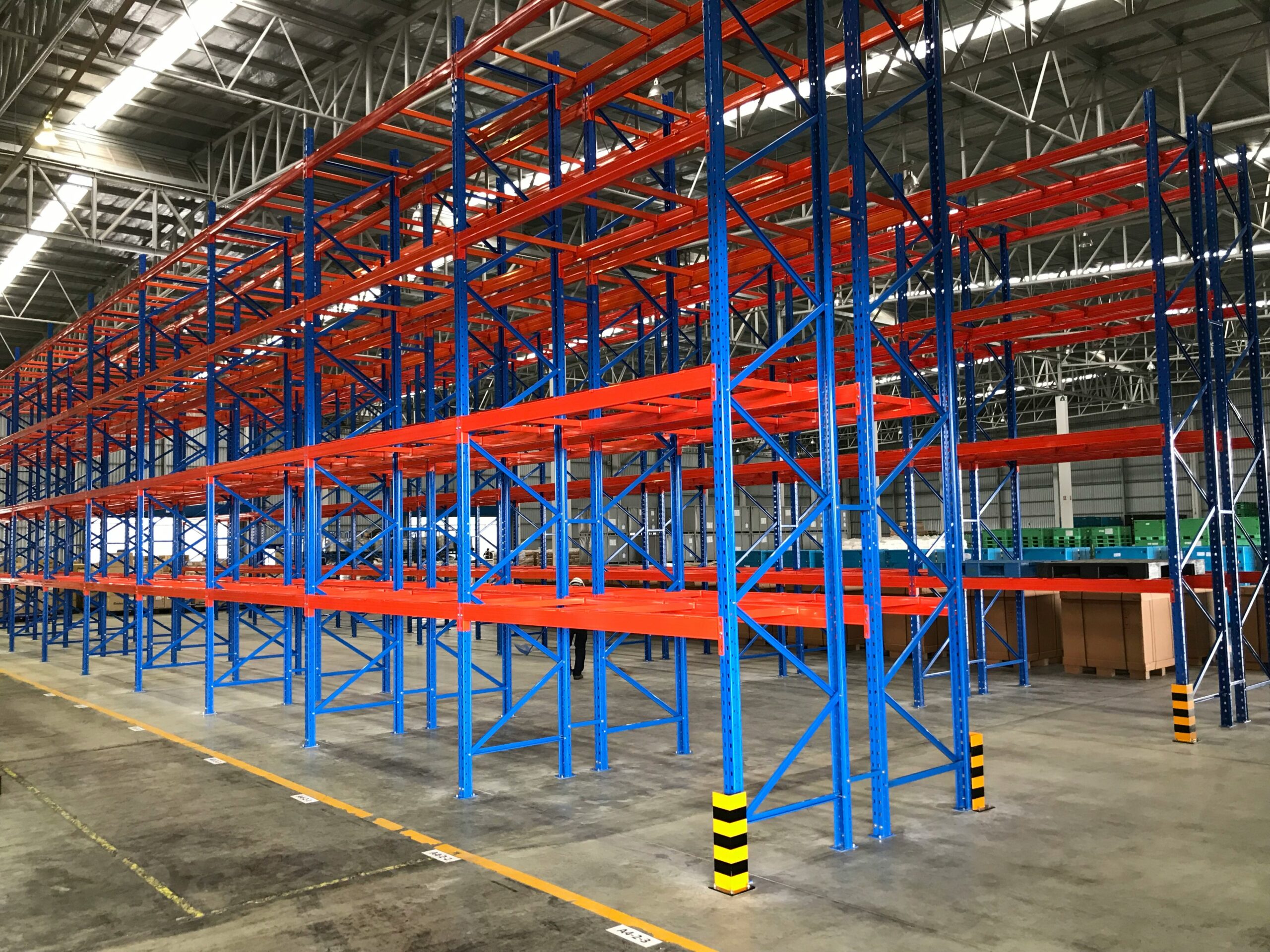
If you haven’t heard about the new rack code, ANSI MH16.1-2021 (and 2023), outside of this article, you will soon. The new RMI (Rack Manufacturer Institute) code is referenced to be used in the IBC 2024, which some states have already adopted. Once jurisdictions adopt the IBC 2024, they will only grant permits to projects designed using this new rack code.
There are many differences between the current and new rack codes, most of which only the engineers need to worry about. But if you are selling racks in any way, listen up, because some of the new changes affect you too!
Why Is There a New Rack Code?
The “current” rack code is dated 2012 (yes, that’s right – it’s 13 years old at the time of this article). The official name is the ANSI MH16.1 – 2012.
The American National Standards Institute (ANSI) requires that a new code be written at least every 10 years, so RMI got the new code approved in the nick of time in 2021.
Many other codes are updated every few years, so as you can imagine, the rack code was a bit outdated since it hadn’t been revised in 9 years.
For the sake of this article, I will boil all of the technical updates down into something more digestible, since the updates ultimately affect everyone selling racks.
How Does the New Rack Code Affect Me?
For those of you who don’t like beating around the bush, I’ll get straight to the point. As a result of the new rack code, there are two things I want to notify you of right off the bat.
1) Some designs that worked for the current code may not work for the new code.
2) Capacity charts (or anything that is used for “static” capacities, for that matter) will be invalid.
Why?
The current code uses a magnification factor was meant to cover structural effects that can’t be captured in simple design procedures.
This magnification factor is what made it possible to calculate “static” capacities.
But the aforementioned structural effects have a big impact on the design of the rack and, unfortunately, the magnification factor doesn’t accurately account for them.
Why Will Some Designs that Work with the Current Code Not Work with the New Code?
Part of what the magnification factor was supposed to capture is something called “2nd order effects.” Unlike the simplified requirements of the current code, in the new code we need to be precise in calculating these effects.
I will explain it in more detail further in the article, but the two images below show the difference in how a rack row deflects with and without 2nd order effects.
You can see that the rack row considering 2nd order effects deflects a lot more than the rack without it.
Without 2nd Order Effects:

With 2nd order Effects:

The magnification factor doesn’t always cover the impact that 2nd-order effects have on the rack. So, in those cases, the new code may yield beefier frames, connections, or base plates/anchors compared to what works with the current code.
Why Capacity Charts are Invalid with ANSI MH 16.1-2021
One thing that is incorrect about the calculation of “static” capacities using the current code’s magnification factor is that these static capacities don’t take into account where the load is on the rack. Typically, to look up the static capacity of a frame on a capacity chart, you’ll just need the weight and the beam spacing.
Below you’ll see two rack rows, each with 9000 lbs on each frame in the row. You’ll see that the row with the larger weight at the top shelf deflects a lot more and differently than the row with the smallest load on the top shelf. The images below demonstrate that the location of the loads affects the rack design, which can’t be captured in a capacity chart.
The methods in the new code capture this effect, while the simplified methods in the current code cannot.

Does This Mean That All the Projects Done with the Current Code Won’t Work?!?
This is a good question, but this new rack code is just a result of engineering and technology getting better in our industry.
Instead of using a single magnification factor that is intended to be appropriate for ALL cases, we now have more engineering knowledge and more advanced tools, like OneRack, that allow us to be more precise in our rack design.
Other industries and disciplines go through the same progression and, just like the other industries, all of the projects done with the current code are considered safe and designed in accordance with the governing codes.
Only new projects and manipulation of existing projects will need to be done in accordance with the new code if at least IBC 2024 has been adopted in the jurisdiction.
Nerd alert! The next couple of sections may seem technical, but I’ll keep it short and simple.
What are these “effects” I speak of? Below, I will cover the two effects I refer to in this article.
Out-of-Straight/Out-of-Plumb
No rack is perfectly straight. Whether it was fabricated that way (out-of-straight) or it was due to installation (out-of-plumb), a perfectly straight rack doesn’t exist.
The rack code limits the out-of-plumb to 0.5in per 10ft of height after the rack is installed (L/240). So that means a 40ft tall rack can be “leaning” 2in and still be in tolerance.
What happens when you load a rack that is leaning? The below images show how a perfect plumb rack (left) deflects, while a rack that is leaning (right) within tolerance deflects.

The effects of this on the structure are an increase in bending at the connections and on the columns.
The new rack code requires us to more accurately analyze this effect, rather than just using the aforementioned magnification factor.
2nd Order Effects
To get more granular than what was already explained in this article, there are 2 different “orders” of analysis. 1st order, and 2nd order.
1st order is simple to understand: you put load on a structure and it deflects.
2nd order considers this fact: the load is still on the structure.
So as the structure deflects, the load is now in a new position to make it deflect more, then more, then more, and so on until the structure is done deflecting.
Most solutions in our industry use a magnifier (a different one than the magnification factor mentioned above) to approximate the 2nd order effects.
But more advanced solutions like OneRack use precise methods to capture their impact on the rack.
Try OneRack’s Pro Version, Completely Free
Get a 30-day free trial and start creating approved rack prelims within minutes.