
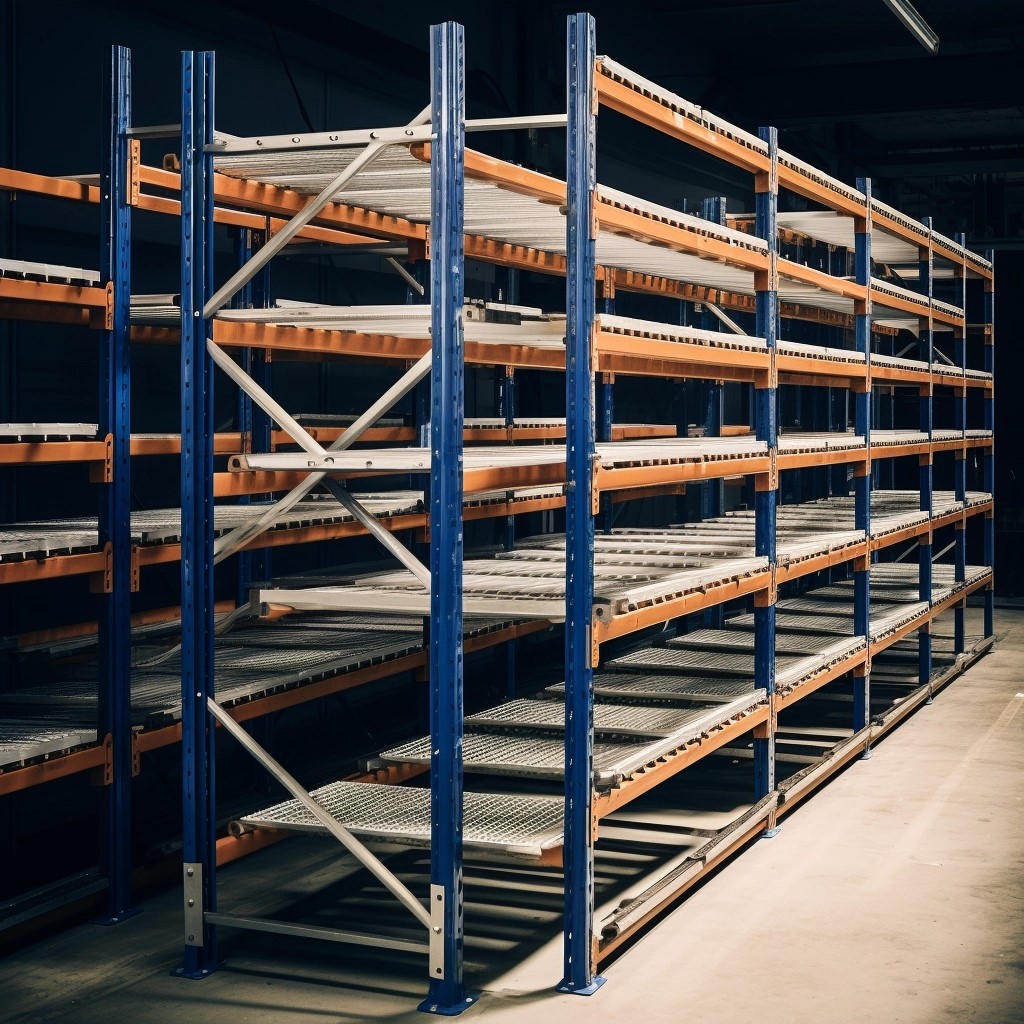
In warehousing and logistics, it’s crucial to optimize space, efficiency, and labor costs.
If you have specific requirements for storage, flow racks can be extremely helpful. These systems use gravity to move products from the loading side to the picking side, supporting first-in, first-out (FIFO) inventory management while reducing manual handling.
Flow racks operate on a simple principle: items are loaded at one end and move along inclined rollers or wheels to the discharge end, where they are available for picking. This design can reduce travel time and improve picking efficiency without the need for powered equipment.
However, while flow racks can reduce certain labor demands, they do not eliminate risk. Proper design, installation, and use are essential to prevent hazards such as uncontrolled product movement, overloading, pinch points, and ergonomic strain during loading and picking.
These systems offer a unique approach to storage, capitalizing on the principles of gravity to streamline the movement of goods within a warehouse.
In this article, we talk flow racks, assessing their types, advantages, disadvantages, ideal use cases, and how they stack up against other storage systems.
What Is a Flow Rack?
At its core, a flow rack is a storage system designed to seamlessly move goods within a warehouse or distribution center.
Often referred to as gravity flow racks, these systems leverage the force of gravity to transport products from a loading point to a picking point.
This innovative design minimizes the need for manual labor, as products move effortlessly along a predetermined path.
Flow racks go by various names, reflecting their adaptability and diverse applications. Apart from the mentioned gravity flow racks, these systems are also known as dynamic flow racks, carton flow racks, or roller racks.
These names underscore the dynamic nature of these systems, emphasizing their ability to handle different types of goods and cater to various industries.
Different Types of Flow Racks
Flow racks come in various types, each tailored to specific storage needs and industry requirements. The primary types include carton flow racks, pallet flow racks, and combination systems that integrate selective and flow rack features.
1. Carton Flow Racks
Designed for smaller items, carton flow racks use roller tracks or wheels to enable the smooth movement of cartons. These are ideal for warehouses dealing with fast-moving consumer goods where a high picking rate is crucial.
2. Pallet Flow Racks
Geared towards larger items and palletized goods, pallet flow racks employ a gravity-fed conveyor system, ensuring a first-in, first-out (FIFO) inventory flow. This system is advantageous for perishable goods and industries requiring strict adherence to product expiry dates.
3. Combination Systems
Some warehouses employ a combination of selective and flow rack elements. This hybrid approach allows for flexibility in accommodating various-sized items and optimizing storage capacity.
4. Specialty Flow Racks
Specialty flow racks are designed for unique loads such as drums, barrels, and kegs. While they use the same gravity-fed principle, they are built to safely handle specific shapes and weights.Due to the higher risk of rolling or shifting loads, these systems should include controls like brakes, stops, and containment features. Always ensure racks are properly designed, installed, and used according to manufacturer specifications and OSHA material handling guidance.
Understanding the specific requirements of your inventory is crucial when deciding on the type of flow rack to implement. Factors such as product dimensions, weight, and turnover rate play a pivotal role in determining the most suitable configuration.
Flow Rack Advantages
The adoption of flow racks has advantages that contribute to the efficiency and cost-effectiveness of warehouse operations.
Efficiency in Loading and Unloading: Flow racks excel in optimizing loading and unloading processes. With a gravity-driven design, products move effortlessly along the inclined plane, eliminating the need for manual transportation. This not only accelerates the order fulfillment process but also reduces the risk of errors and damage during handling.
Reduction in Labor Costs: The automation inherent in flow racks results in a significant reduction in labor costs. By minimizing the manual effort required for moving and picking goods, companies can reallocate human resources to more complex tasks, enhancing overall operational efficiency.
Improved Inventory Visibility: Flow racks organize SKUs into dedicated lanes, making stock levels easy to assess at a glance. This helps teams identify low inventory quickly and reorder in time to avoid stockouts.
Reduced Product Damage: When properly designed with speed controls and stops, gravity-fed movement can reduce impacts compared to manual handling or dense forklift operations, helping minimize product damage.
Better Worker Ergonomics: Flow racks present products at a consistent, accessible height, reducing excessive reaching, bending, and searching, helping lower fatigue and the risk of repetitive strain injuries.
Flow Rack Disadvantages
Despite their numerous advantages, flow racks are not a one-size-fits-all solution, and there are certain drawbacks to consider.
Initial Investment: Implementing a flow rack system requires a significant upfront investment. The costs associated with the installation of inclined tracks, conveyor systems, and other necessary components can be a barrier for smaller businesses with limited budgets.
Limited Flexibility: Flow racks are optimized for specific types of goods and industries. This specialization may lead to limited flexibility in accommodating diverse inventory, especially for businesses dealing with a wide range of product sizes and weights.
SKU Restrictions Per Lane: Flow racks are most effective when each lane is dedicated to a single SKU to maintain proper product flow and FIFO. Operations with frequently changing SKUs may face challenges with lane management, increasing the risk of misloads, product jams, and reduced efficiency.
Industry Use Cases
Flow racks provide the strongest return in industries that share certain traits: high product turnover, date-sensitive inventory, and repetitive picking operations.
Common applications include:
- Food and beverage distribution – ensures FIFO for perishable goods.
- Pharmaceutical warehousing – supports accurate inventory rotation and compliance.
- E-commerce fulfillment – speeds up picking and order processing for high-volume SKUs.
- Cold storage facilities – requires corrosion-resistant racks for refrigerated environments.
- Retail back-stock areas – maximizes storage density and reduces restocking time.
- Automotive parts storage – allows organized, first-in-first-out access to components.
- Manufacturing assembly lines – ideal at point-of-use or kitting stations where small parts must be continuously available for operators, ensuring smooth workflow and minimal handling.
When to Use Flow Racks
Determining when to use flow racks involves a careful assessment of your warehouse’s specific needs and operational requirements.
High-Turnover Goods: Flow racks are particularly beneficial when dealing with high-turnover goods where a FIFO inventory system is crucial. Industries such as food and beverage, pharmaceuticals, and e-commerce can benefit significantly from the streamlined product movement offered by flow racks.
Space Optimization: If your warehouse space is limited, and maximizing storage capacity is a priority, flow racks are a viable solution. Their design ensures efficient use of vertical space, allowing for higher storage density compared to traditional shelving systems.
Flow Racks vs Other Racks
To make an informed decision, it’s essential to compare flow racks with other popular storage systems, namely Selective Racks, Push Back Racks, and Drive-In Racks.
Selective Racks: While selective racks offer accessibility to each individual pallet, they may not be as efficient in terms of space utilization and order picking speed compared to flow racks.
Push Back Racks: Push back racks share some similarities with flow racks in terms of space optimization. However, they operate on a Last-In, First-Out (LIFO) inventory system, making them more suitable for certain industries with different requirements.
Drive-In Racks: Drive-in racks are designed for high-density storage but may not provide the same level of accessibility and FIFO inventory flow as flow racks. The choice between the two depends on the specific needs of the warehouse.
Flow Rack Installation and Maintenance
Installing and maintaining a flow rack system requires careful planning and periodic attention.
Installation: The installation process involves setting up the inclined tracks, conveyor systems, and ensuring a proper slope for the gravity-driven movement of goods. Professional installation is recommended to ensure the system’s integrity and functionality.
Maintenance: Regular maintenance is essential to ensure the smooth operation of flow racks. This includes inspecting rollers, wheels, and conveyor systems, as well as addressing any issues promptly to prevent disruptions in warehouse operations.
Cost Considerations: Flow racks are higher-density dynamic storage systems, with installation typically 20–35% of equipment cost, compared to 15–25% for selective pallet racks. While the upfront investment is higher, benefits such as reduced labor, fewer damaged goods, and faster picking cycles often provide strong ROI for high-turnover operations.
Flow Rack FAQs
Can flow racks handle large and heavy items?
Flow racks are versatile, but their efficiency is maximized when dealing with smaller to medium-sized items. For larger and heavier goods, alternative storage solutions may be more suitable.
Are flow racks suitable for industries with diverse product sizes?
While flow racks can be customized for different products, they are most effective when dealing with a relatively uniform inventory in terms of size and weight. Businesses with highly diverse product ranges may need to consider hybrid systems or alternative storage solutions.
What is the lifespan of a typical flow rack system?
The lifespan of a flow rack system depends on various factors, including usage intensity and maintenance practices. With proper care, these systems can last for many years, providing a good return on investment.
Can flow racks be integrated with existing warehouse management systems?
Yes, flow racks can be integrated with warehouse management systems (WMS) to enhance overall inventory management and order fulfillment processes. Compatibility with WMS may vary based on the specific system and its features.
What slope angle do flow rack rollers need?
The incline on a flow rack lane is carefully engineered, not arbitrary. For pallet flow racks, the pitch is typically 3–4%. Carton flow racks often use a slightly steeper angle, usually 4–6%, depending on carton weight, size, and roller friction. The goal is a controlled, consistent roll speed that moves product forward without causing it to crash into the pick face. Braking systems or speed controllers are often installed on heavier pallet lanes to manage descent safely and reduce the risk of injuries or product damage.
How deep can flow rack lanes be?
Lane depth depends on system type and product. Carton flow racks typically range from 4 to 12 feet deep, based on carton size and storage requirements. Pallet flow racks can hold several pallets per lane, with some deep-lane configurations accommodating 20 or more pallets.
Deeper lanes increase storage density but require careful planning for aisle access, pallet consistency, and safe picking practices to minimize handling risks.
So…Are Flow Racks Right for Your Project?
When considering efficiency and cost-effectiveness for your warehouse, flow racks are a compelling solution.
Their ability to streamline loading and unloading processes, reduce labor costs, and optimize space makes them a worthy consideration for businesses seeking to enhance their logistics operations.
However, careful consideration of the specific needs of the warehouse, product characteristics, and industry requirements is crucial in determining whether flow racks are the right fit for a particular project.
OneRack Lets You Design Winning Flow Racks—Within Minutes
Our groundbreaking new software allows you to become your own structural engineer. Within minutes, you can have approved flow rack prelims today. You can try this software for free by clicking here and getting a free 30-day trial of the Pro version.
Try OneRack’s Pro Version, Completely Free
Get a 30-day free trial and start creating approved rack prelims within minutes.